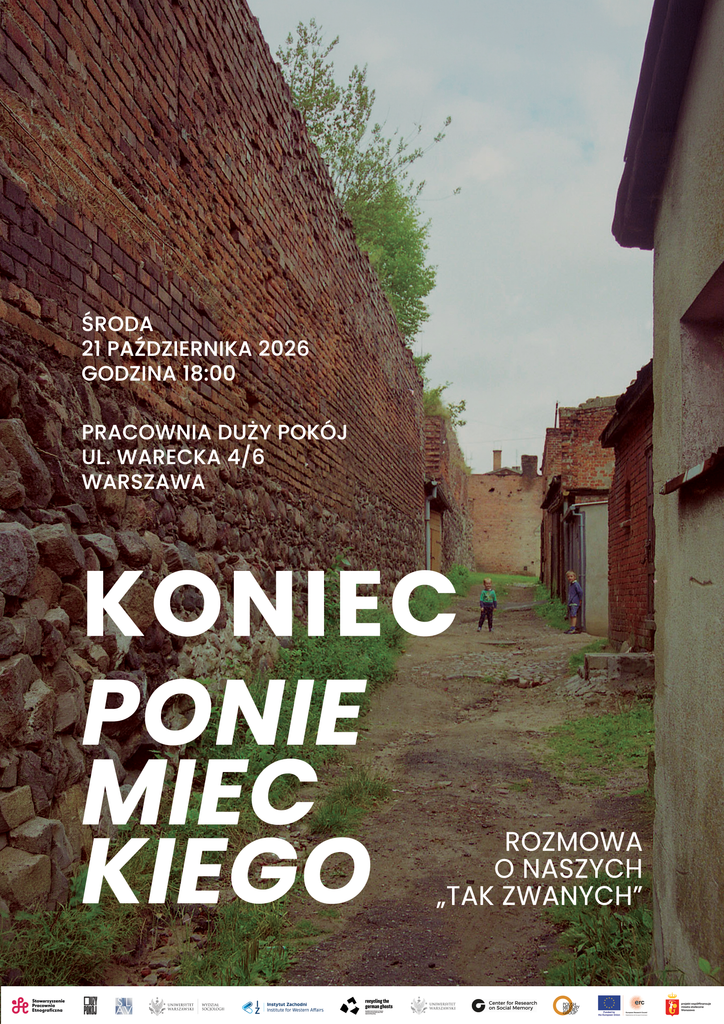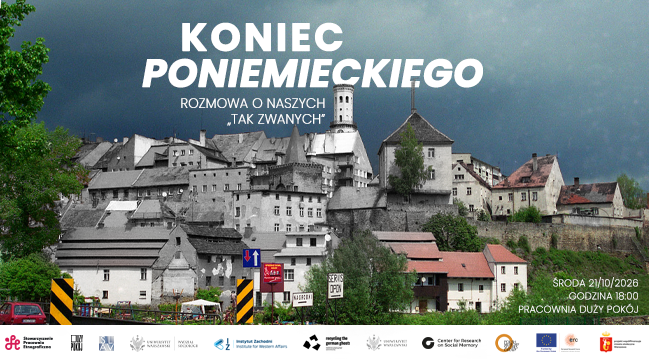
📅 Wednesday, 21 October 2026, 6:00 pm
📍 Pracownia Duży Pokój, ul. Warecka 4/6, Warsaw (entrance from Kubusia Puchatka Street)
Why in 2026 did a municipality in Western Pomerania use a mug featuring a Nazi to promote itself? How should we understand the identities of Wrocław, Szczecin and Zielona Góra: as formerly German or Polish? Can a granary serve as a museum, and who decides how such places and their histories are presented?
Many of the terms we use to describe our history are still preceded by the phrase “so-called”, as in the case of the “Recovered Territories”. This linguistic distance says much about our relationship with the past. Despite more than eighty years of research into the displacement of German populations and the resettlement of territories incorporated into Poland after the Second World War, the material and cultural legacies of the “formerly German” have only relatively recently entered mainstream Polish popular culture.
This discussion examines how understandings of the “Recovered Territories” are changing and being debated today. How do we use the term “formerly German” today, and how does it shape not only our understanding of the past but also the places we live in and our everyday experiences? Which stories about these territories do we tell, which remain untold, and which receive the most attention? We will also consider how a post-war project of social engineering has evolved in ways that its creators could not have anticipated.
The discussion will feature dr Małgorzata Bukiel (Institute for Western Affairs in Poznań), dr Małgorzata Łukianow (Faculty of Sociology, University of Warsaw) and our own Karolina Ćwiek-Rogalska. It will be moderated by dr Helena Patzer (Institute of Ethnology and Cultural Anthropology, University of Warsaw).
The event is co-organised by Stowarzyszenie „Pracownia Etnograficzna”, Pracownia Duży Pokój, the European Union (ERC, Spectral Recycling, 101041946), Institute of Slavic Studies, Polish Academy of Sciences, Faculty of Sociology, University of Warsaw, Institute for Western Affairs in Poznań, Centre for Research on Social Memory, and Polish Memory Studies Group.