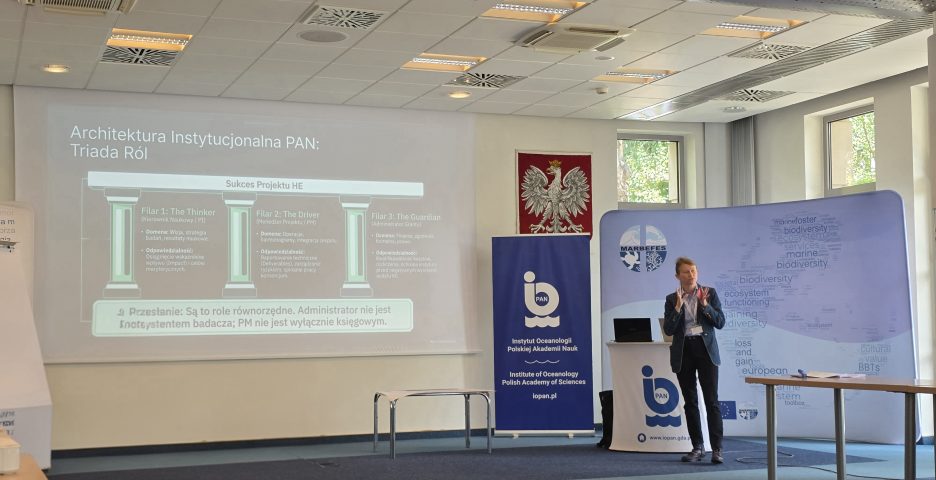
On 21–22 September 2026, Angelika Zanki, our project manager and facilitator, participated in the workshop “PolSCA Masterclass – Advanced Workshop: Research Project Management Using the PM² Methodology”, organised by the PolSCA – Polish Science Contact Agency in Brussels, in cooperation with the Institute of Oceanology of the Polish Academy of Sciences in Sopot. The workshop, led by Dr Agnieszka Grzegorczyk, a trainer and expert in project management in the R&D sector and public administration, had a strongly practical focus and provided an opportunity to directly relate the topics discussed to real-life challenges encountered in the implementation of research projects.
Working on projects funded under ERC grants requires continuous updating of knowledge, becoming familiar with new management methodologies, and improving approaches to work organisation and team collaboration. During the two-day workshop, Angelika had the opportunty to deepen her knowledge of the application of the PM² methodology to research project management, with particular attention to the specific characteristics of projects implemented within European funding programmes. PM² Methodology, developed by the European Commission, provides a methodology for effectively managing projects. It offers practical guidelines, management activities, and best practices that can be tailored to the needs of organisations and teams. A significant part of the training focused on project planning and monitoring, tracking milestones and outcome and impact indicators, as well as requirements related to periodic and final reporting.
Another important component of the training was the development of competences in risk, issue and project change management. Participants worked on methods for identifying and classifying risks, maintaining a risk register, and developing appropriate risk response plans. Additionaly, the workshop covered project communication and diplomacy, particularly in situations requiring coordination, agreement and negotiation within teams and consortia.
Participants were introduced to the potential use of prompt engineering and AI tools to support communication, negotiations and day-to-day administrative work. Particular attention was given to the Human-in-the-Loop and AI-Copiloting models, which can support the streamlining of processes while retaining human responsibility for decisions. The topic of artificial intelligence generated an extensive discussion among the participants, highlighting the need to establish clear principles and guidelines for the use of various AI tools in the day-to-day administration of European research projects.
An important part of the training was also the analysis of the research project life cycle, from initiation through to project closure, including work with real-life scenarios and the exchange of experiences and good practices. The workshop addressed as well the respective responsibilities of the individuals involved in project implementation, helping to further clarify roles and areas of cooperation within the project.
Participation in the training enabled Angelika to expand and update her competences in ERC project management, as well as to become familiar with new tools and working methods that can be applied to the ongoing implementation of the project. At the same time, Angelika actively shared her own experience and proposed solutions to practical challenges arising in the context of working on the aforementioned project, thereby contributing to the exchange of knowledge and good practices among the workshop participants.