
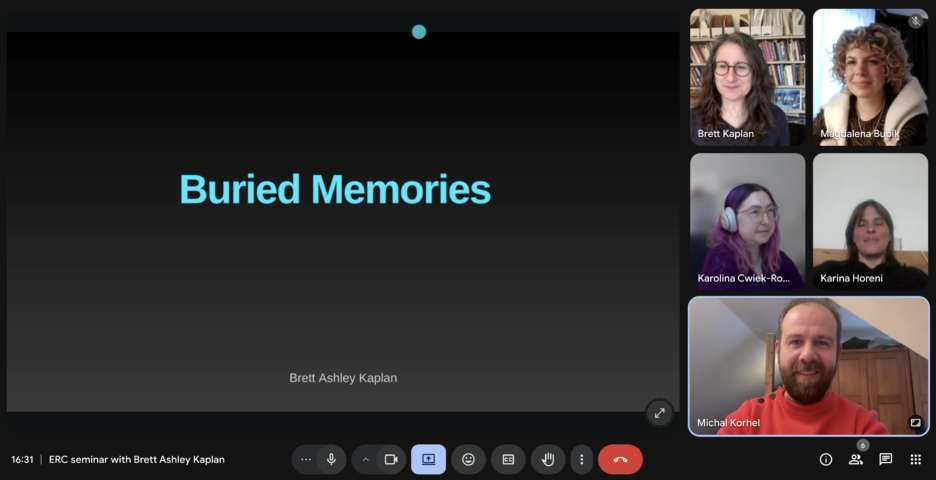
In February, our team had the pleasure of hosting a seminar with Brett Ashley Kaplan, Professor and Conrad Humanities Scholar in the Program in Comparative and World Literature at the University of Illinois Urbana-Champaign, where she directs the Initiative in Holocaust, Genocide, and Memory Studies. During the seminar, our guest presented not only a portion of her research but also offered insight into the creative process behind her recent book on the now-vanished village of Seneca Village, located in the nineteenth century on the grounds of what is today Central Park in New York City.
Together, we reflected on what “haunting” truly means—whether it should be understood solely as a feature associated with figures (“human” ghosts), or whether it may also belong to objects. This question resonated particularly strongly in the context of our project, which explores the agency of things and the material traces of the past. The conversation then expanded to the issue of memory tied to specific spaces—how bringing new information about the past to light affects contemporary communities and what kinds of reactions it can provoke. We also considered the differences between the work of writers and scholars—how both groups gather and interpret data, construct narratives, and combine facts with imagination.
For our team, the seminar only broadened our research perspective but also opened up new questions about the relationship between place, memory, and that which—though seemingly absent—continues to shape the present. We particularly appreciated that our guest introduced us to the context of New York City, with its entangled memories of Indigenous and Black communities, erased from the white history.