
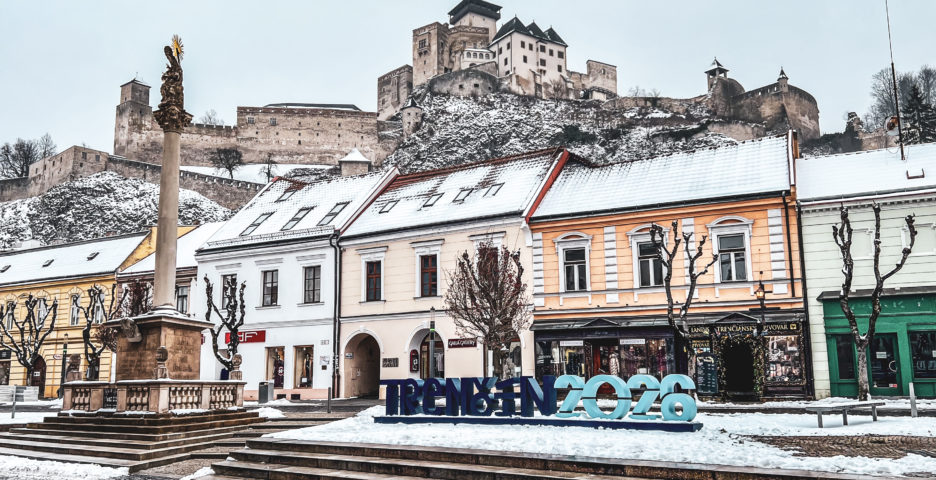
At the end of March, a thematic evening dedicated to the European Capital of Culture Trenčín 2026 project took place at the premises of the Embassy of the Slovak Republic in Berlin. The event, organized by the Slovak Institute in Berlin in cooperation with the Deutsches Kulturforum östliches Europa, offered a diverse program focused on history, cultural memory, and contemporary interpretations of the city and its region.
The evening program was divided into several thematic blocks. Particular attention was given to Jewish heritage, with the history of the Trenčín synagogue presented within the broader context of the history of the Jewish community in Slovakia. A strong personal dimension was added by Eva Umlauf, who shared her memories of growing up in Trenčín and her experience as a Holocaust survivor. The literary segment introduced contemporary works connected to the city, while the musical accompaniment enhanced the atmosphere of the event and underscored its multicultural character.
The historical segment of the evening then focused on Slovak–German cultural heritage in the region. In this context, our researcher Michal Korhel presented the issue of German settlement in the so-called Hauerland region, using the town of Handlová and its surroundings as a case study. The presentation was based on his field work and explored the traces of German heritage in the region, as well as contemporary forms of remembrance and reinterpretation of the German presence. In his contribution, Michal highlighted the ambivalent nature of this heritage, which oscillates between historical continuity and discontinuity shaped by post-war developments. In conclusion, he emphasized that German heritage should not be seen solely as a closed chapter of the past, but as a dynamic element of the present.
Following the presentation, Michal engaged in a discussion with Brunhilde Reitmeier-Zwick, Federal Chairwoman of the Carpathian German Association in Germany. Together, they addressed broader questions of cultural heritage preservation, identity, and the intergenerational transmission of memory within the context of the Carpathian German community. The discussion highlighted the importance of dialogue between historical research and the perspectives of those who actively carry this tradition forward.