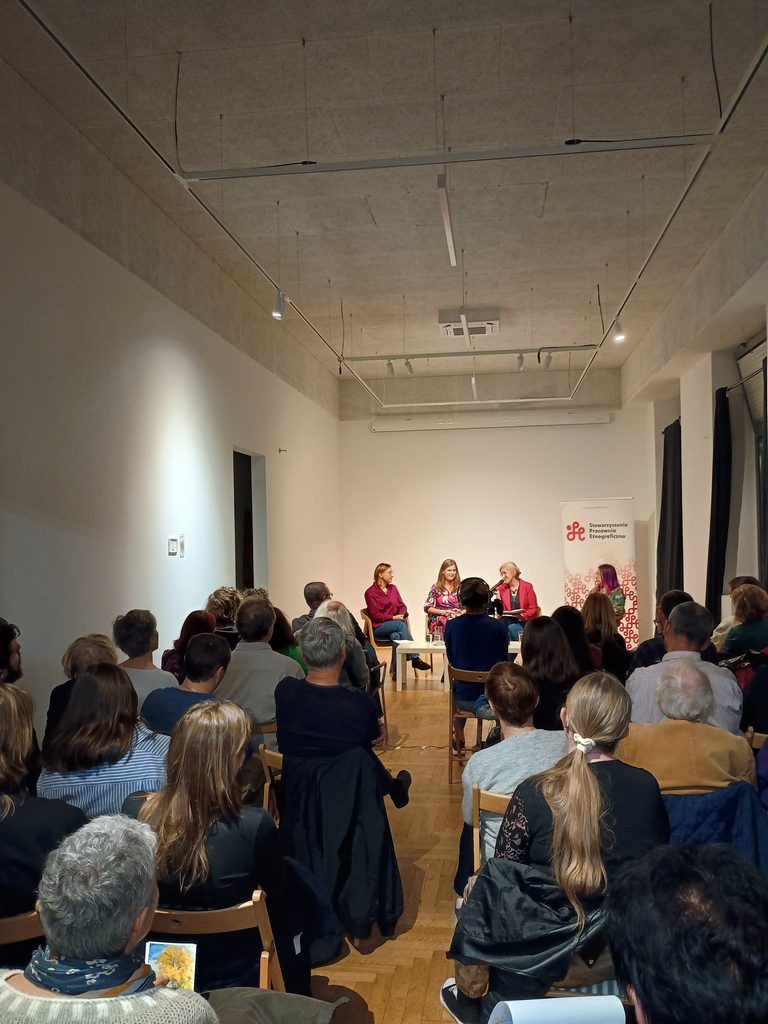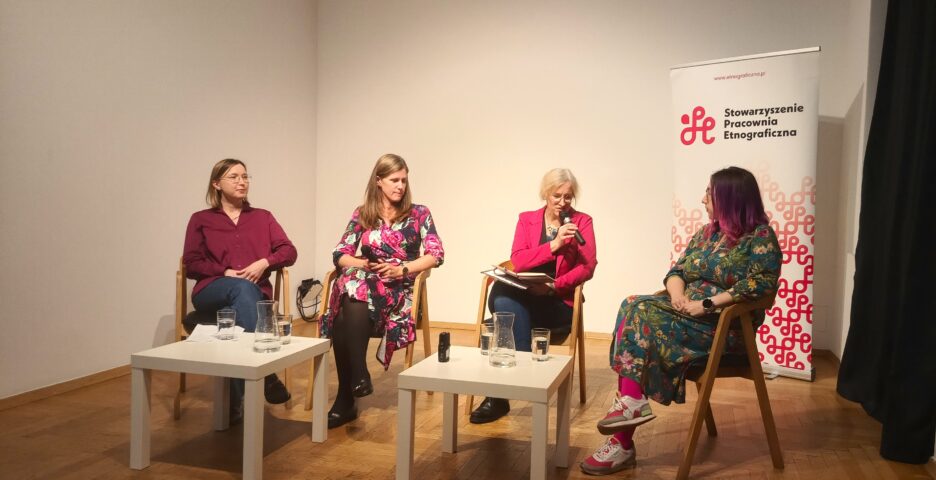
What paradigms shape how we think about Poland’s post-displacement regions? Has the meaning of “formerly German” changed over the past 80 years, as these regions have become part of Poland and successive generations of settlers have created new meanings along the way? To explore these questions, we gathered at the welcoming space of Pracownia Etnograficzna on Warecka Street in Warsaw on the evening of 21 September 2026.
The discussion was moderated by anthropologist Helena Patzer, who is currently conducting research in the Krajna region, between Poland’s “Recovered Territories” and its “Elder Lands”. The three researchers who took part in it, represented the disciplines of sociology, history, and anthropology. Małgorzata Łukianow, a sociologist and author of the recently published book “Memory in Postmigration Communities: Fields of Memory”, reflected on her research in the Powiśle and Łużyce regions. Małgorzata Bukiel, responsible for the recent sociological survey report “There are no Recovered Territories anymore” shared her insights coming from the report as well as her research in the Lubusz Land region. Last but not least was our own Karolina Ćwiek-Rogalska.
Małgorzata Łukianow opened the discussion by explaining that the title of the debate, “The End of Former Germanness”, was not an attempt to dismiss previous research, but rather a starting point for asking what we still do not fully understand and which concepts deserve a closer look. Karolina added examples from our team’s research, comparing the situation in Poland with that in Czechia. Małgorzata Bukiel presented the findings of her team’s sociological survey, emphasizing that she, too, sees them as a starting point for further discussion. All three researchers agreed that we still lack adequate language to express the experience of post-displacement.
The debate was streamed online, but above all, it brought together a substantial audience. Many people had to stand once Pracownia ran out of chairs. During the discussion that followed, which lasted over an hour, participants raised questions about the moral dimensions of “formerly German” heritage, the difference between “autochthonous” and “formerly German”, and how German scholars are responding to the ongoing debate on these issues in Poland.
We were happy to co-organize this event and look forward to more collaborations like this one!